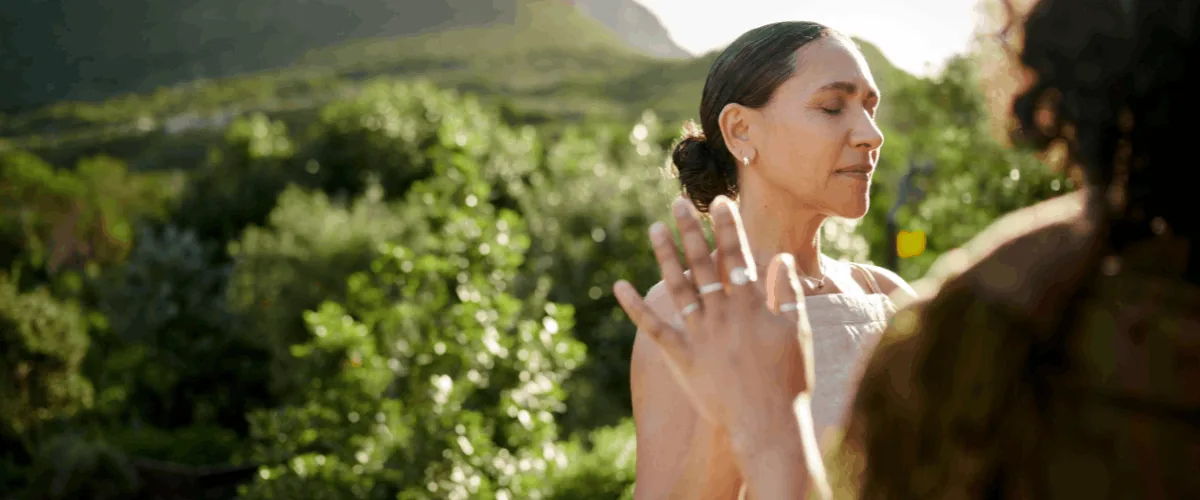
What does somatic mean?
Somatic work recognises that the body holds wisdom beyond the conscious mind. Through breath, movement and sensation, you notice and work with the patterns that live in your physiology: how you hold tension, how you brace, what your body does before your mind has an opinion.
You do not need a yoga or movement background. Practices are guided, simple and adjusted to the room.
How the days are spent
The mix is indicative and is adjusted to each cohort.
- Somatic practice: 25–30%
- Games and theatre: 20–25%
- Peer circles and dialogue: 20–25%
- Reflection and clarity mapping: 15–20%
- Rest, nature and integration: 10–15%
The five practices
- Somatic and embodied practice. Breath, movement and grounding, to reach what thinking cannot.
- Games and theatre. Role reversal, improvisation and mirror work reach patterns that conversation politely avoids.
- Circle dialogue. Small peer groups, where people discover their private predicament is a common one.
- Guided reflection. Mapping the distance between the life being lived and the life wanted.
- Integration scaffolding. Monthly group calls for six months, because insight without structure tends to fade.
Why a small group
Sixteen people is small enough for every voice to be heard and varied enough that you meet perspectives other than your own. Trust builds faster in a room this size, and the cohort is curated by application so the room is right for everyone in it.
What happens after the retreat
Insight without structure tends to fade, so the retreat is followed by six months of guided integration: monthly group calls, a peer partnership and ongoing facilitator support.
Honest limits
Renovo Path is not therapy, coaching or medical treatment. If you are in acute distress, in active addiction or living with untreated severe mental illness, please seek professional care first. We say so plainly and are happy to refer you onward.
Last updated 25 October 2026.