By Renovo Path Team · · 7 min read · Practices
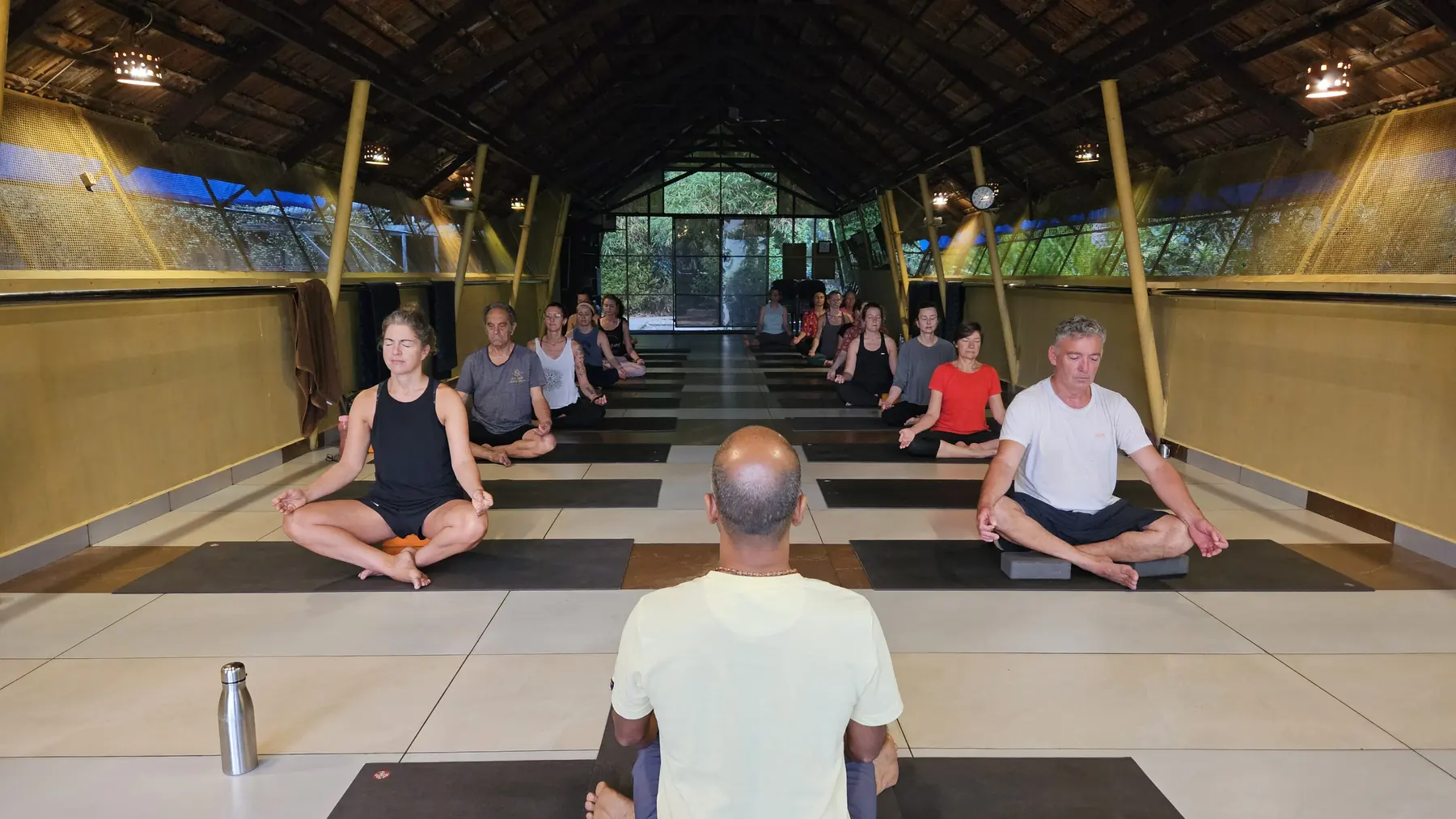
Yoga nidra, often translated as yogic sleep, is a guided practice of deep relaxation in which you lie still while a voice leads your attention through the body, the breath and a series of images or intentions. It is meant to be a state between waking and sleeping, in which you remain aware while the body rests. It is widely taught in yoga schools and, in recent years, used in some wellness and clinical settings.
This guide explains what yoga nidra is, where it comes from, how a session usually runs, how to try it, what research suggests and who should take care.
What yoga nidra means
Nidra is the Sanskrit word for sleep, and yoga nidra is usually rendered as yogic sleep or conscious sleep. The idea is to enter a deeply restful state while staying aware, rather than falling asleep. In practice, many people drift in and out, and that is common.
The term appears in older Indian texts with various meanings. The modern, systematised form of the practice taught today was developed and popularised in the twentieth century, notably by teachers such as Swami Satyananda Saraswati of the Bihar School of Yoga, and has since spread widely.
How a session usually works
A session typically lasts from fifteen to forty-five minutes. Shorter versions are available, and many people use recordings.
- You lie on your back on a mat or blanket, covered and comfortable, with eyes closed.
- The teacher invites you to settle, and sometimes to set a short intention, called a sankalpa.
- Your attention is guided through the body, part by part, in a rotation of awareness.
- You may be guided to follow the breath and to notice sensations, sounds or opposites such as heaviness and lightness.
- There may be visualisations, or a return to the intention.
- The session ends with a gradual return to the room, movement of fingers and toes, and a slow sitting up.
How it differs from sleep and from meditation
Yoga nidra is not sleep, although many people do fall asleep. It aims at relaxed awareness. It also differs from sitting meditation, which usually asks for an active, upright attention, whereas yoga nidra is done lying down and invites you to follow instructions. Many people find it easier than sitting, particularly when tired.
It shares elements with a body scan, but usually adds structured stages, visualisation and an intention. The two overlap, and the line between them is not strict.
What people report
People who practise yoga nidra often describe feeling deeply rested, calmer and clearer afterwards. Some use it to help with winding down before sleep, others to recover from a long day. A few experience vivid images, emotions or memories. Some do not feel much, and fall asleep, which is also fine.
These are personal reports and do not guarantee any particular effect. As with other practices, results vary, and the value often lies in making a regular habit of rest.
What research suggests
Research on yoga nidra is growing and includes small studies suggesting it may help with stress, anxiety, sleep quality and wellbeing in some people, though many studies are small, short or lack rigorous controls. Systematic reviews generally conclude that the evidence is promising but limited, and that larger, better-designed studies are needed.
It is therefore sensible to see it as a promising relaxation practice rather than a proven treatment. If you have a medical or mental-health condition, use it alongside the care your doctor recommends, and do not stop treatment.
A simple version to try at home
Ten to twenty minutes is plenty. You can read the steps aloud to yourself or record them. Many people prefer a recorded guide in a calm voice.
- Lie down comfortably, with a blanket and a pillow under your head or knees if you like.
- Take three slow breaths, and let your body feel heavy.
- Silently set a short, positive intention in the present tense, such as 'I am calm and steady'.
- Move attention slowly through your body: right hand, arm, shoulder; left hand, arm, shoulder; legs; back; head and face.
- Rest in the sensation of the whole body for a minute, then follow your breath for a few breaths.
- Repeat your intention once, then take a deeper breath, wiggle fingers and toes, and open your eyes.
Setting an intention (sankalpa)
In traditional practice, a sankalpa is a short statement of resolve, formed with care and repeated at the beginning and end. It is meant to be brief, positive and in the present tense, for example 'I am at ease' or 'I listen to myself'. Choose something realistic and kind, not a demanding goal.
If you are unsure, you can leave it out, or simply set an intention to rest. Some people find that the choice of words changes over time, as they learn what they most need.
Who should take care
Most healthy people find yoga nidra safe. If it brings up strong feelings, you can end the practice at any time, ground yourself by feeling your feet and looking around the room, and talk to a professional if needed.
- People with a history of trauma, panic or dissociation, for whom lying still with closed eyes may feel unsafe
- Those with severe depression or psychosis, who should speak to a professional first
- Pregnant women, who may need to lie on their side or with support
- People with back or neck problems, who may need props
- Anyone who feels distressed during a session, who should open their eyes and stop
Using yoga nidra for sleep and recovery
Because it is a lying-down relaxation practice, yoga nidra is popular in the evening and as a recovery tool. A twenty-minute session in the afternoon can be a restful break. At bedtime, a shorter version may help you let go of the day, and falling asleep partway through is fine.
If you have persistent sleep problems, speak to a doctor. Relaxation practices can help, and they work best alongside good sleep habits: regular times, a dark cool room and less screen use before bed.
How it relates to a retreat
At a retreat, a guided relaxation or body-based practice may be used to help participants settle, rest and integrate. It is one of many ways of listening to the body. For people who find sitting hard, practices such as yoga nidra or body scans can be gentler routes in.
If you try yoga nidra at home, treat it as an experiment. Notice how you feel afterwards, and keep what helps. It is a simple way of giving yourself a few minutes of deliberate rest.
Practical tips for a comfortable session
Small comforts make a large difference. Arrange the space before you begin, so that you can let go once you lie down.
- Choose a quiet time and place, with a mat or a firm bed
- Use a blanket, as body temperature can drop during rest
- Place a cushion under the knees if your lower back is sensitive
- Cover your eyes with a soft cloth if the light is bright
- Turn off notifications, and tell people at home you will be unavailable
Working with sleepiness and restlessness
If you tend to fall asleep, practise earlier in the day or with your head slightly raised. If you feel restless, allow small movements, and let the guide's voice be a background. Over several sessions, many people find that the body learns the pattern and relaxes more easily.
Notice, without judgement, what happens in your sessions. If you often feel agitated, that may be a sign that you need movement or conversation first. There is no single right experience.
Yoga nidra and daily rest
Many busy people find it hard to rest without guilt. A short yoga nidra session, even ten minutes, can become a deliberate pause in the day: not a nap, not a task, simply rest with attention. Over time, regular practice may help you recognise tiredness earlier and rest before you are depleted.
Common questions
Is yoga nidra the same as sleeping?
No. It aims at deep relaxation with some awareness, though many people fall asleep, and that is fine.
How long does a session take?
Usually fifteen to forty-five minutes. Shorter versions are also common.
Is yoga nidra scientifically proven?
Research is promising but limited. It may help with stress and sleep for some people, and it is not a proven treatment for any condition.
Who should avoid it?
People with trauma histories or severe mental illness should speak to a professional first. Stop if you feel distressed.
Keep reading
If this sounds familiar, the Silent Gap explains the pattern, and the free Silent Gap guide gives you six questions to sit with. The next Renovo Path retreat is in Kochi, Kerala, on 24–27 December 2026, by application.